
The RBI seems to be acknowledging that all deposits are not equal -- a deposit with a lower run-off assumption is inherently more valuable than one that could disappear overnight, points out Tamal Bandyopadhyay.

State-owned Bank of Baroda (BoB) reported a 72 per cent year-on-year (Y-o-Y) drop in net profit to 1,278 crore for Q1FY27 due to a $600 million out-of-court settlement related to NMC Health Plc. In contrast, Bank of India (BoI) saw its net profit rise by 36.23 per cent Y-o-Y to 3,068 crore for the same quarter, driven by healthy loan growth and improved asset quality.

L&T Finance reported a robust Q1FY27 with net profit growing 29% year-on-year to 900 crore, driven by strong asset growth and strategic initiatives including accelerating cross-selling, improving productivity, and fostering a technology-first, AI-led culture, alongside significant expansion in gold loans.

HDFC Bank, India's largest private-sector lender, has revised its FY27 growth trajectory, stepping back from earlier guidance to align with a more measured 12 per cent year-on-year expansion, citing geopolitical uncertainties.

One 97 Communications Ltd, operating Paytm, is set to issue its first bonus shares, following a landmark year of achieving its maiden full-year profit and gaining significant market share. The board will meet on July 20 to decide on the bonus issue, reflecting confidence in its financial strength and aiming to improve stock accessibility for retail investors.

Banking credit in the economy grew by 11.1 per cent year-on-year (Y-o-Y) in the fortnight ended March 7, while deposits grew at 10.2 per cent during the same period, which is a gap of around 90 basis points (bps), according to the latest data from the Reserve Bank of India (RBI).

Amid liquidity tightness in the banking system, certificate of deposit (CD) rates topped 8 per cent for some smaller banks, with rates remaining on the higher side for derivatives loss-hit IndusInd Bank. On Thursday, CSB Bank raised Rs 100 crore via one-year CDs at 8.5 per cent, while Utkarsh Small Finance Bank issued three-month CDs at 8.05 per cent to raise Rs 50 crore.

With deposit growth remaining sluggish and the credit - deposit ratio of commercial banks crossing 80 per cent, banks have ramped up their borrowing in the certificate of deposit (CD) market. In the fortnight ended November 14, CD issuances climbed to nearly Rs 55,000 crore - double the borrowings of the preceding two fortnights and the highest since the September 19 fortnight.

'Healthcare costs in India rise by 10 to 14% annually, causing treatment costs to double roughly every 5-7 years.'

The government bond yield curve is likely to flatten in the financial year 2027 (FY27) as the Reserve Bank of India (RBI) is expected to ease supply pressure in the ultra-long segment. In FY26 so far, reduced investments by insurance companies and pension funds pushed up yields on ultra-long tenor securities, steepening the curve.

Sanjay Malhotra has made structural changes to banking regulation to bring down costs and increase efficiency. Plus, he kicked off a benign interest regime. But there are challenges ahead.

'When there is such an elaborate and a strong process, one would have expected anyone to either place the issues so that they can be addressed or go to the regulator and probably tell them rather than creating a kind of uncertainty for the stakeholders.

Public-sector banks (PSBs) are attracting the attention of investors and the PSU Bank Index has gained nearly 10 per cent in the past month. PSBs have seen return on assets (RoA) climbing to 1 per cent in 2024-2025 (FY25) and margins are believed to have moved up further in the first half of this financial year (H1FY26) with asset quality remaining stable.

The banking sector could see better loan growth in the third quarter of financial year 2026 (Q3FY26) with improved net interest margins (NIMs), though the full impact of latest rate cuts will be largely felt in the fourth quarter. There may be lower slippage in unsecured loans and microfinance institutions (MFIs) along with steady recovery trends, which should lower credit cost.

Axis Bank reported a sharp drop in net profit in the second quarter of financial year 2026 (Q2FY26) on higher provisions and weak operating profit growth while revenue growth was moderate. But loan growth and deposit growth improved to double-digits year-on-year (Y-o-Y) and asset quality also improved with the gross non-performing loan or NPL ratio moving down.

With rising credit demand, cleaner balance sheets, and renewed investor confidence, banks are positioned at the forefront of the market rally. From major players like ICICI and HDFC to broader policy shifts, there's much driving this momentum.
With rising credit demand, cleaner balance sheets, and renewed investor confidence, banks are positioned at the forefront of the market rally. From major players like ICICI and HDFC to broader policy shifts, there's much driving this momentum.
With rising credit demand, cleaner balance sheets, and renewed investor confidence, banks are positioned at the forefront of the market rally. From major players like ICICI and HDFC to broader policy shifts, there's much driving this momentum.

In view of the rising number of mobile and internet banking users, the Reserve Bank of India (RBI) has proposed to tighten norms related to the liquidity coverage ratio (LCR) by increasing the run-off factor for retail deposits. "Banking has undergone rapid transformation in recent years. "While increased usage of technology has facilitated the ability to make instantaneous bank transfers and withdrawals, it has also led to a concomitant increase in risks, requiring proactive management," the RBI said in the draft guidelines released on Thursday.

'Bank has enabling provision to raise capital up to Rs 7,500 crore over a longer period of time.'

Since Sanjay Malhotra took office as governor in December, the Reserve Bank of India (RBI) has adopted a more accommodative stance, which bodes well for banking and the economy as they navigate a growth slowdown, according to analysts.

India's largest PSU bank, State Bank of India, delivered excellent results, once the impact of a big jump in employee expenses was adjusted for. The net interest income (NII) beat the Street due to a better net interest margin (NIM) and good loan growth. The credit growth at 5.2 per cent quarter-on-quarter (Q-o-Q) (15 per cent year on year) was excellent for a large bank.

'Challenge is basically near-term growth as the outlook has turned a bit adverse.'

India Inc, which is sitting on cash balances of 13.5 trillion, is using the funds to meet capital expenditure as well as brownfield expansion, resulting in 'anaemic' demand for bank loans, State Bank of India (SBI) chairman CS Setty said at an event on Monday. He added that a slowdown in corporate credit is mainly due to lack of demand.

The move by the central bank follows concerns over tight liquidity conditions and banks' unwillingness to lend to NBFCs.

In 2025 banks are in for challenges such as pressure on margins and slowing credit growth. With the likelihood of a repo rate cut in February or April, external benchmark-linked loans of banks will be repriced immediately. However, deposit rates are expected to adjust more gradually, which could impact the net interest margin (NIM) - a key measure of profitability for banks.
The Reserve Bank on Monday said asset quality of banks improved further and their gross non-performing assets (GNPA) or bad loans ratio declined to a 12-year low of 2.6 per cent in September 2024 on the back of falling slippages and steady credit demand. The RBI also flagged concern over a sharp rise in write-offs, especially among private sector banks (PVBs), which could be partly masking worsening asset quality in unsecured lending segment and dilution in underwriting standards.
An NBFC must actively manage its collateral positions, differentiating between encumbered and unencumbered assets, and monitor such assets so that they can be mobilised in a timely manner, central bank says in circular.

'Afterwards, some improvement is expected.'
Banks have issued Rs 7.78 trillion worth of CDs in the current calendar year until August 2024, compared to Rs 4.9 trillion in the same period of 2023, registering a 59 per cent growth
The Reserve Bank of India on Monday said that RBL Bank is well capitalised and its financial position remains "satisfactory", amid speculations relating to the private sector lender in certain quarters in wake of recent events surrounding the bank. In a statement, the Reserve Bank of India (RBI) also said there is no need for depositors and other stakeholders to react to speculative reports. The bank's financial health remains stable, it said.

Use these loans to meet emergency needs, and not to fund holidays or luxury purchases.

Shriram Finance's (SHFL's) profit after tax (PAT) rose 10 per cent year-on-year (Y-o-Y) to Rs 2,140 crore in the fourth quarter of the financial year 2024-25 (Q4FY25).

HDFC Bank has been conscious in not accepting high-cost deposits, which have resulted in slower growth in October-December, said Sashidhar Jagdishan, managing director and chief executive officer, during an interaction with Goldman Sachs recently. He said during times of tight liquidity, short terms hardened, as was the case in October-December. "Not only did we participate, but we also gave up which came up for maturity," he said.

Treasury gains helped ICICI Bank post a nearly 10 per cent increase in the consolidated net profit for the April-June quarter at Rs 11,696 crore on Saturday. Growth in the core income slowed for the country's second largest private sector lender, but the treasury operations helped it report a 14.62 per cent rise in its post-tax profit at Rs 11,059 crore on a standalone basis. The core net interest income (NII) growth came at a multi quarter low of 7.3 per cent to Rs 19,553 crore for the reporting quarter.

Only a limited set of investors should invest directly in corporate bonds.
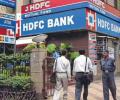
The merged entity's deposits grew by 16.2 per cent YoY at Rs 20.63 trillion at the end of the first quarter. Sequentially, the merged entity's advances rose by about 0.7 per cent to Rs 22.30 trillion as of March 31, 2023. However, the pace of deposit mobilisation was higher at 1.2 per cent over Rs 20.39 trillion as of March 31, 2023.

'It is nice that the banking system is in good shape.' 'It is a little early to call it too good because I think it was too bad in the past.'

'Investors can consider staying invested in long duration products as there is a possibility of rate cuts in the near term.' Positive macros - lower inflation, high forex reserves and favourable demand-supply dynamics for government bonds - make a strong case for rate cuts from December, says Devang Shah, head of fixed income, Axis Mutual Fund. In an interview with Abhishek Kumar in Mumbai, Shah says this view may not hold true if commodity prices go up sharply.

One should avoid keeping excessive funds in one's savings account.
